Managing Swim Up & DI
Contact Us
Seasonal Hours
Open 7 days a week
10:00AM - 5:00PM
Managing Swim Up & DI
鈥淪wim-up鈥 is a stage that occurs when alevin become fully developed (when they鈥檙e called fry). Prior to that point, alevin have been living on the bottom of the breeder basket, but when they approach being 85 or 90% developed, they start making tentative movements towards the surface. Experienced fisheries biologists like Roxbury hatchery鈥檚 Jeremy Whalen can recognize the fairly subtle cues that indicate the alevin have reached the swim-up stage. But听TIC teachers and volunteers, who observe only a comparatively small number of alevin and who raise trout just once a year, usually find it very difficult to spot the telltale signs of the swim-up stage. As a result, we need to use听data听to predict when alevin will swim up.
And for this, we鈥檝e created a data entry sheet and a special 鈥渟wim-up calculator,鈥 which you can find .听 Two quick notes about the Excel and Google Sheets files contained in this folder:
- One is an听Excel听workbook called 鈥淭emp and DI record and swim-up calculator鈥; another is a听Google Sheets听workbook of the same name. Both contain听four听worksheets. The first provides instructions, the second is used to听PREDICT swim-up and to record water temperature data, the third will allow you to听SCHEDULE听辞谤听CONTROL when the fry swims up, and the fourth you won鈥檛 need to use; it simply allows a formula to perform a 鈥渓ookup鈥 function.
- If you鈥檙e going to use the Excel workbook, in order for the formulas to work, you need to open the Excel file,听not听be looking at the file from within a Web browser such as Chrome. Download the spreadsheet and save it to your hard drive. (If you don鈥檛 have Excel, use the Google Sheets document.)
- The other two files are Excel and Google Sheets spreadsheets that you should use for recording temperature, pH, water chemistry readings, etc. It鈥檚 important that you also record egg or fry mortality and other observations such as swim-up behavior.
It鈥檚 extremely important to know when your fry are approaching 85 or 90% development (DI = 85) because that鈥檚 when the fry should be swimming up and looking for food. But the swim-up stage lasts only a few days鈥搃t鈥檚 a briefly opened window鈥揳nd, if you miss it, you鈥檝e听missed it, probably for good! So it鈥檚 critical to know when to be looking for the telltale signs of the swim-up phase and to be able to spend time watching for those signs so that you can respond to them appropriately. See the resources below.
Improving Your Breeder Basket
The breeder baskets that come with the ThatPetPlace.com TIC kit consist of a simple plastic frame and a drawstring net bag that is, according to the breeder basket instructions, meant to be installed around the outside听of the frame.
There are two problems with this design. First, when you put the net bag around the frame, alevin will frequently get caught between the frame and the netting, where they鈥檒l die. Second, the mesh of the net bag is so fine that it traps all fish waste and uneaten food. As a result, unless you clean the bottom of the net very diligently and do so often, an unappealing mess develops that breeds bacteria that can foster if not cause fatal gill infections.
There are two ways to address these issues.
- Modify the breeder basket
We recommend that you replace the bottom panel of the net bag with coarser screen material.听
To achieve this improvement, follow these steps provided by Bob Wible.
What you need:
-
- Net breeder basket
- Aquarium caulk (cement)
- Scissors
- Fiberglass screening 4 陆 x 6 陆
- Plastic wrap
- Aluminum wire 18 gauge
Process:
-
- Assemble basket frame.
- Place a large piece of plastic wrap on the bottom outside of the frame (to protect it from the cement).
- Place the net on the frame so that the wrong (unfinished) side of the net is on the outside. Pull loop on net tight so net stretches over the frame.
- Sit assembly upside down. The bottom should be pointing up.
- Squeeze a small continuous bead of cement around the edges of the bottom.
- Place a piece of screening on the cemented area.
- Lay another piece of plastic wrap on top of the screen.
- Turn the complete assembly over on a hard flat surface and press on top so the cement flattens out.
- Let sit for 24 hours.
- Remove the net from the frame and take off both sheets of plastic wrap.
- Let the cement dry for another 24 hours.
- Cut original bottom netting听away from newly installed bottom听screening.
- Wire bottom corners of the modified net bag to bottom-inside corners of the frame.
- Keep your breeder basket clean
Even if you鈥檝e replaced the fine-mesh bottom of a standard breeder basket, it鈥檚 still necessary to monitor conditions at the bottom of the breeder basket and, whenever debris begins to build up, use a siphon or turkey baster to suck up the dirt.
鈥婯eep it as clean as you can!
Predicting Swim Up
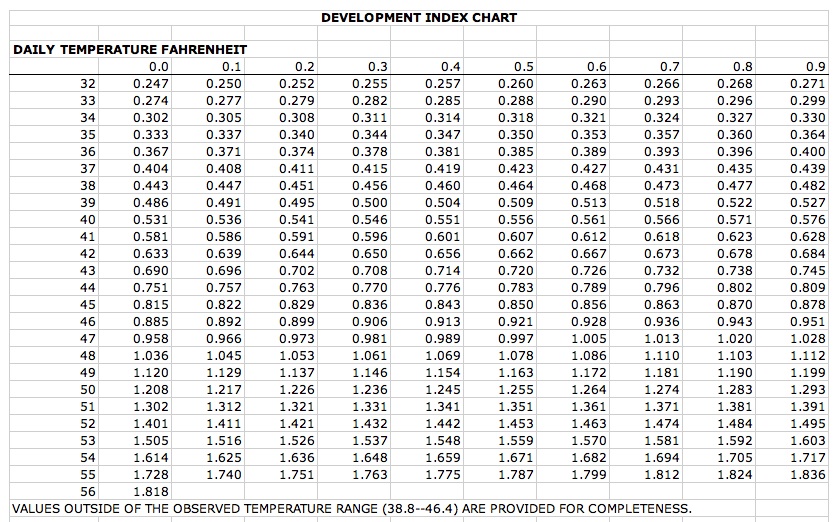
So, for example, at 38.3 degrees, the value of 0.456 is added to whatever the cumulative DI was on the previous day.
鈥婣s mentioned in the previous page, we鈥檝e provided Google Sheets spreadsheets (补惫补颈濒补产濒别听) that will allow you to听predict听when your alevin/fry will swim up. (First, you鈥檒l have to download the Google Sheets file鈥揻ind Download on the File menu.) In what follows, you will want to read the听Instructions听page (Tab A) and, especially, click on Tab B to access the worksheet called 鈥淏. Temp. entry and DI record.鈥
鈥婬ere鈥檚 an image of the four tabs you鈥檒l find at the bottom of the Google Sheets file.
From that point forward, all you need to do is听enter the daily water temperature听into the cell in Column B that corresponds to the correct date. The spreadsheet will automatically calculate the new Cumulative DI.
It is important to enter water temperature data for听every听day, including weekends and schools breaks, even if you haven鈥檛 checked the tank temperature. For those days when you don鈥檛 visit the tank,听estimate听(or interpolate)听鈥媡he water temperature. So if the temperature was 51 when you left on Friday afternoon and it was 49 when you returned to the classroom on Monday morning, enter a temperature of 50 for each of the weekend days.
As your cumulative DI approaches 85, you听should听remove the front and top foaminsulation听(this will help stimulate the swim-up instinct), and you听need to听become very attentive.听Look for evidence of fry swimming to the surface. (You may want to review this 鈥溾澨齮o get some help on identifying what swim-up-ready fry look like.) Fry require careful monitoring at this stage and should be inspected several times every day, including weekends and school breaks.听If some fry start swimming up, provide the tiniest pinch of food. Remove whatever is not eaten after ten minutes. When fry have begun eating reliably, you can feed them as often as five times a day, but always just the tiniest pinch.听
As your fry start to swim up,听keep records听of the percentage that do so in Column E of Sheet B (and of the percentage feeding in Column F of Sheet B). If you and other teachers keep good records and share those with us, we will be able to analyze these data, and this may allow us to improve the formula that we鈥檙e presently using to predict swim-up readiness.
And don鈥檛 let the bottom of the net breeder get too dirty! (More on this later.)
Controlling When Your Fry Swim Up
Sometimes the timing of swim-up can be inconvenient. This critically important stage, which typically lasts only a few days, might happen when you鈥檙e able to monitor your tank closely several times a day, even over weekends.听Or听it could occur over your school鈥檚 spring break, during the few days you are scheduled to attend a professional conference, or at a time when you need to take personal leave to attend to a sick child or ailing parent. In those cases, you鈥檇 want to reschedule swim-up, and you can do this following the procedure described here.
鈥婽he method of controlling/scheduling when your alevin/fry swim up requires you to use Tab A and C of the听鈥溾澨齭preadsheet. (First, you鈥檒l have to download the Google Sheets file鈥揻ind Download on the File menu.)听Here鈥檚 a picture of the four tabs at the bottom of the Google Sheets.
After you鈥檝e read the instructions for听鈥Method 2: Scheduled/planned swim-up date,鈥听click on the tab for Sheet 鈥淐. Swim-up calculator.鈥
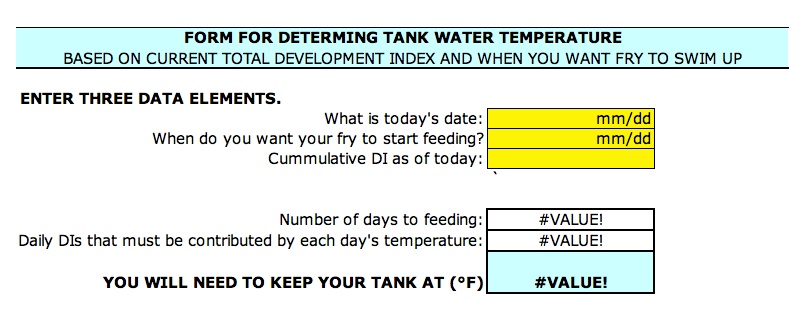
In Cell B5 enter today鈥檚 date. In Cell B6 enter the date on which you want your fry to swim up. (This should be a time when you know you鈥檒l be able to closely monitor the fry.)
Then click on the tab for Sheet 鈥淏. Temp. entry and DI record鈥 and find the 鈥淐umulative DI to date鈥 (Column D) that corresponds to today鈥檚 date. Go back to Sheet C and enter that number into Cell B7. Once you hit Return, Cell B12 will give you the temperature to which your tank should be set and at which it should be consistently maintained. Here鈥檚 what Sheet C looks like.
As you approach the date on which your fish should start to swim up鈥損erhaps beginning four or five days before the planned swim-up date鈥(1) remove the top and front foam insulation during the day and (2) pay very close attention to early signs of swim-up behavior. You should review the document prepared for the Idaho TIC program:
- Feed very sparingly and remove uneaten food after 10 minutes and
- Record the percentage of fry swimming up in Column E (and the percentage of fry eating in Column F) of Worksheet B. These data听will allow us to refine and improve the formula we鈥檙e currently using to predict swim-up.